

Building Regional Capacity
PHSD Supports California Housing Leaders at Inaugural RHFA Exchange
While California’s housing challenges are regional in scale, the institutions and resources needed to address them are often fragmented across jurisdictions and sectors. Regional Housing Finance Authorities (RHFAs) offer one promising approach to bringing those resources together, and three California regions are now charting different paths toward making that vision a reality.
In October 2025, the Partnership to House San Diego (PHSD), alongside other local partners and philanthropic leaders, convened the inaugural California RHFA Exchange in Long Beach, CA, bringing together housing leaders from the Bay Area, Los Angeles, and San Diego for three days of learning, relationship-building, and collaboration.
The Exchange brought together representatives from public agencies, education institutions, philanthropy, advocacy organizations, and other housing partners to explore how RHFAs are formed, how they move from authorization to implementation, and what it takes to build the partnerships and infrastructure necessary for long-term regional housing investment.
Date
October 2025
Format
Three days of learning, relationship-building and collaboration
Site
Long Beach, CA
Participants
PHSD with local partners and philanthropic leaders


Learning from Three Regional Journeys
A central focus of the Exchange was hearing directly from the three regions about their experiences establishing an RHFA.
The Bay Area Housing Finance Authority (BAHFA), the state’s first RHFA, shared lessons from its formation and early implementation. Los Angeles representatives described the extensive community and stakeholder process that led to the creation of the Los Angeles County Affordable Housing Solutions Agency (LACAHSA), as well as the role of state legislation in establishing its authority. San Diego shared the emerging story of the San Diego Regional Housing Finance Authority (SD-RHFA), which was formed through collaboration between San Diego Unified School District and the San Diego Community College District under SB 440.
While each region followed a different path, the conversations revealed common themes. Establishing an RHFA requires more than legislation or a governance structure. It requires relationships, sustained leadership, community engagement, political alignment, and a willingness to develop new approaches to longstanding challenges.
For participants from regions considering or developing their own regional housing finance structures, the opportunity to hear stories directly from those who helped build them provided practical lessons that cannot be captured in a policy document alone.
From Formation to Action
The Exchange additionally explored what happens after an RHFA is established.
Participants learned about BAHFA’s transition from formation into implementation, including its pilot programs and efforts to develop new regional financing tools. LACAHSA shared its experience following the passage of Measure A, a half-cent countywide sales tax, including the development of its expenditure plan and initial programs. These conversations illustrated the different stages of RHFA development and the new questions that emerge as an agency moves from an idea to an operating institution.
A conversation about the LACAHSA Measure A campaign offered another important lesson: regional housing finance is ultimately about building a coalition capable of sustaining a shared vision. The panel explored the extensive organizing, communications, fundraising, government coordination, and community engagement that contributed to the campaign’s success.
These discussions reinforced a central theme of the Exchange: regional housing capacity is built through relationships as much as through institutions.

Strengthening Connections Across Regions
Creating space for those relationships was a key objective of the Exchange.
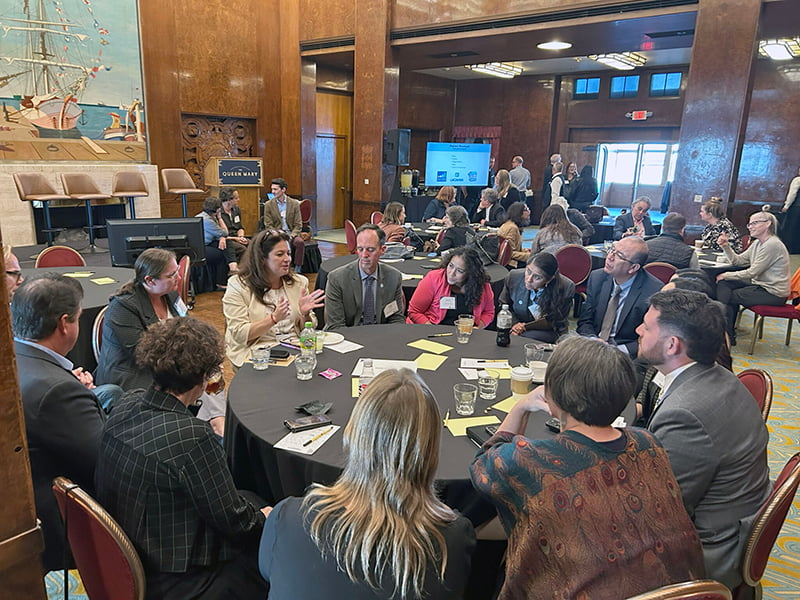
Participants spent time in regional breakout groups reconnecting with colleagues, sharing their current work, and discussing goals for the Exchange. These conversations provided an opportunity for people who had not connected deeply in some time to reestablish relationships and begin identifying areas for greater alignment.
The Exchange also encouraged participants to look across regional boundaries. By placing the Bay Area, Los Angeles, and San Diego experiences in conversation with one another, participants could identify both common challenges and approaches that might be adapted to their own regional contexts.
For San Diego, this cross-regional learning comes at an especially important moment. SD-RHFA is in its early stages of standing up operations, developing its governance and advisory structures, and exploring approaches to capitalization. Learning directly from BAHFA and LACAHSA provided San Diego with an opportunity to benefit from the experience of regions further along in their RHFA journeys.
PHSD’s Role in Advancing Regional Collaboration
The RHFA Exchange builds on the collaborative model that has defined PHSD’s work since its launch in 2023.
PHSD brings together philanthropic leaders, education institutions, public-sector organizations, and faith-based organizations to identify opportunities to advance housing solutions through collective action. The formation of a regional housing finance authority became a priority action in PHSD’s 2025 workplan, reflecting the partnership’s focus on building the regional capacity needed to address San Diego’s housing challenges.
The Exchange extended that work beyond San Diego by creating a forum for regions across California to share their experiences and learn from one another. It also reinforced the value of the cross-sector relationships that are at the heart of PHSD’s approach.
As San Diego enters the next chapter of SD-RHFA’s development, the relationships established and strengthened through the Exchange will provide an important foundation for continued learning and collaboration.
Looking Ahead
The inaugural RHFA Exchange demonstrated what is possible when regions come together not simply to share information, but to build relationships, exchange lessons, and develop a shared understanding of the opportunities and challenges ahead.
The three regions are at different points in their journeys, but their experiences point toward a common opportunity: building stronger regional institutions and partnerships that can bring greater resources, capacity, and coordination to California’s housing challenges. PHSD is proud to foster that collaboration and looks forward to continuing to bring partners together as San Diego and other regions across California advance this work.
The Exchange was a starting point for a growing community of regional housing leaders committed to learning from one another and building the capacity to create more housing solutions at scale.